Sunday, October 08, 2023

Uluru….Alice Springs….Australia

Anzac Hill

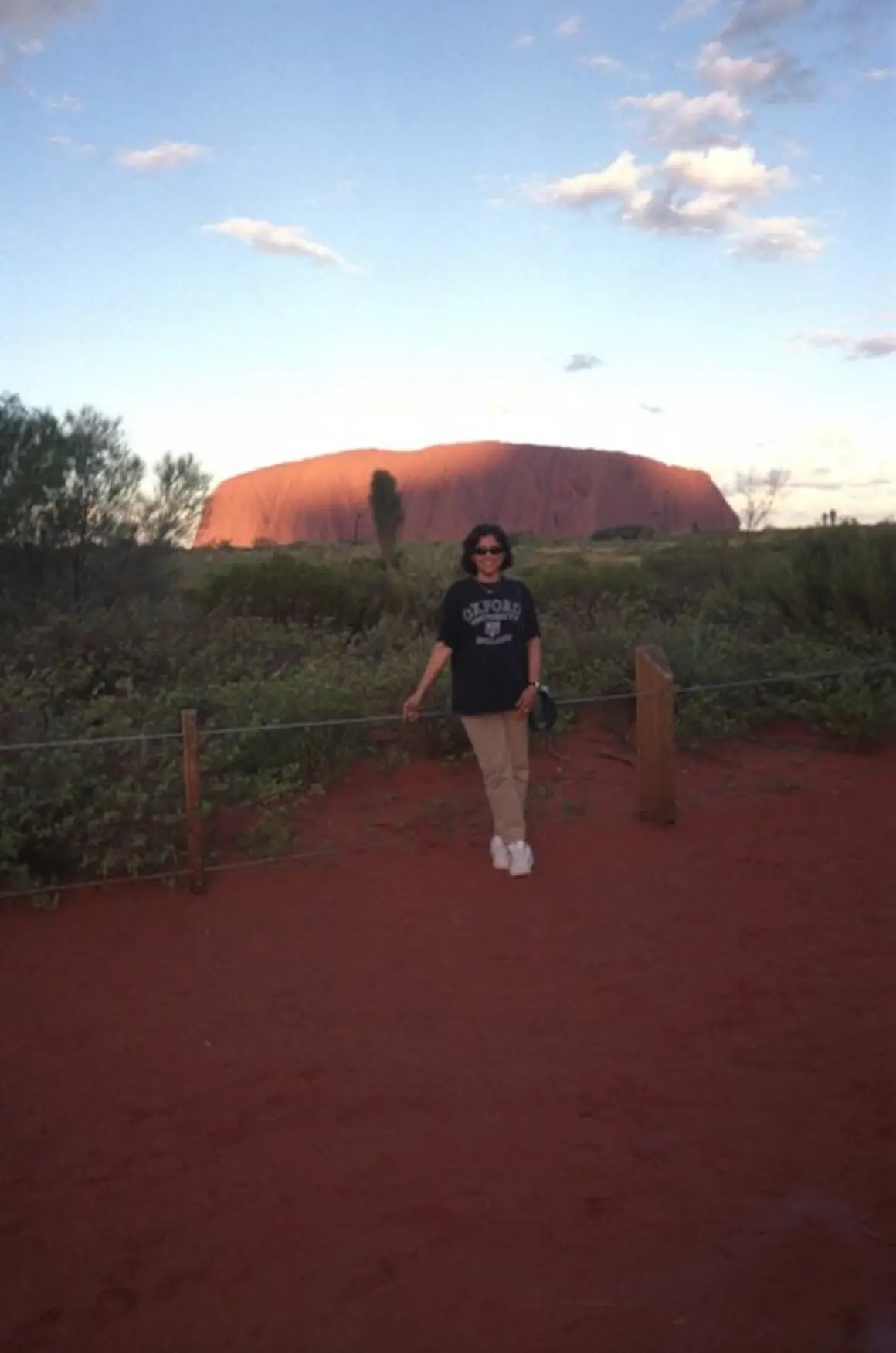
I was looking into my old diaries and found the write up on my trip to Uluru.  Flew to Alice Springs from Melbourne
on a cool day in July 2005. Alice Springs is the closest airport to Uluru or Ayer’s Rock in the Red center of the Outback. Alice Springs became famous during the WWII when Australia and USA set up a communication hub.Another fun part is one can find camels roaming in the wild. These animals were brought from Afghanistan to carry loads for military and rail road construction. They were abandoned in the wild to become happy campers! 


My first stop is to visit the Anzac hill a monument for the soldiers. Next day went on a day trip to the Emily Gap and the National park. Our guide  is from the Arrernte tribe the original inhabitants of this region. The Arrernte art is now World famous with its unique colors and dots. 

After familiarizing with Northern Territory, I headed off to Uluru Kata Tjuṯa National Park in a tourist van equipped to handle the red dust of the desert. Uluru has a circumference of 9.4km and 348 meters high. This monolithic sandstone rock is about half a billion years old. The Anangu people who live around this area consider Uluru as their most sacred place and they do not like people climbing on it. Hiking around the circumference is ok for them. The name”Anangu” sounded very familiar to me as it is a Tamil word. Also the tradition of not climbing or walking on something which is considered sacred whichever religion or belief is also part of the Sanatan Dharma. Hence I decided to hike even though some people from my tour group chose to climb. 

The hike around the rock showed its hidden treasures like the rock art and the impression of the wave with fish preserved in the fossilized rock. 


The rock changed its color from orange to crimson red along with the sun slowly getting ready to set. I just watched with awe  and wonder. I heard the Nature whispering “Everything is dynamic. Once I was a shallow sea in the Gondwana stretch” Now I aam a desert and the hidden rock emerged as Uluru”. 


All content copyright © by Sobana Iyengar.

Saturday, April 17, 2021

Baltic countries ....Estonia... Tallinn......

Visiting Tallinn came up during the conversation in the Hilton lounge Helsinki. A young Estonian joined us for the drinks and gave us the snapshot of the Estonian history. Tallinn is only 87km by ferry from Helsinki and no visa is required for US citizens. 
The decision is unanimous, must go!
Next day we boarded the ferry and arrived in Tallinn. Our guide was waiting at the port and took us to vist the palace and Peter the Great’s summer residence.  A very rustic and small structure converted into a museum in the middle of a beautiful garden. The palace is now turned into the Government house. The well kept gardens, fountains reminded me of Vienna. The maritime museum near theTallinn port show case EML Lembit the submarine that survived the World War II. The Seaplane Harbour museum has 100 years of history. Peter the Great built this as his naval fortress with its column less thin shell concrete structure. Amazingly preserved and our guide was very proud to show us around. 

Old town Tallinn is the tourist hub and the cobble stone streets remind the heydays of the Merchant guild or Hansa. The well preserved 12th century St. Mary’s Cathedral and the Russian orthodox Alexander Nevesky’s church display the contrast in the architecture from the gothic to the domes of Eastern Orthodox tradition.  Estonia is now a secular state after the fall of communism in 1991.
It is in a strategic point connecting St. Petersburg in Russia and also a vantage port in the Baltic Sea.
There are many restaurants and our guide recommended the Olde Hansa with a medieval menu. Vegetarians have no choice only salad! So we browsed around the adjacent shop that has so many varieties of candles, soaps and medieval Estonian artifacts.  Walking around the old town smelling the food, made us feel hungry. Time to relax and rest our feet. The unanimous choice was Chakra an Indian restaurant situated in the old town. Very nice ambience. The food and the service was great. The hot ginger tea energized us to explore the history around us. After visiting many cities in both western and Eastern Europe, I understand pattern of wars, the personas and human aberrations. Every war or migration provide lessons. Looks like we are in that eternal learning! Hopefully peace will prevail.


All content copyright © by Sobana Iyengar.

Sunday, July 26, 2020

Magyar....Budapest.....Hungary......


Hungary located in Central Europe came to organized power during the 9th century. A country famous for paprika, Dobos Hungarian sponge cake, music, folk dances, spas etc.  First time I visited Hungary in 2003 and  later in 2014.  Budapest changed from a cultural city to a high tech city in 2014. The Lion's Bridge, the palace and the museums remain the same. It was poignant to see the Shoes on the Danube Bank in memory of the Jews killed in the holocaust.  In 2003, there were only few Indian restaurants. Now, 
Budapest has all types of cuisine served by the Restaurants. The best ones are the cafes and eateries along the banks of the Danube River. The best paprika krumpli can be found here. I ordered the vegetarian version with potatos.  The liberty square and the monuments remind the struggles of Hungary during the World War II and the Hungarian revolution in 1956. 


All content copyright © by Sobana Iyengar.
Sunday, May 03, 2020

Mermaid.....Danish......Copenhagen....


Denmark reminds me of Shakespeare's Hamlet and Hans Christian Andersen's The Little Mermaid".  I have to admit that I like Danish cheese also. In 2018, decided to visit this country again as a tourist. Last time I visited it was a business trip and hardly had time to visit the castles. This time a much-awaited vacation and stayed in the Marriott Copenhagen. 

The Baltic Sea breeze was soothing. the sail boats, trawlers, the ships and the usual harbor hustle bustle were perfect setting to visit the Viking Museum. After the museum visit, we headed to see the iconic Mermaid.  The little mermaid is a bronze statue set up on a rock in the harbor facing the Langelinie promenade. Edvard Eriksen sculpted the statue. The sad look of the Mermaid or I could be imagining that she looked sad. 


The next day visited the Kronborg Castle popularly called as the Hamlet's castle immortalized by the English bard Shakespeare!  It was about an hours' drive from Copenhagen winding thru the farms and the coast. The guide narrated the history of the castle from 1400's, the fires that engulfed, rebuild, Swedish control and how Danish took it back etc.. etc.. 
Enjoyed a nice lunch in the city of Elsinore with a veggie wrap and the famous Danish Havarti cheese.  The concierge in the hotel recommended VeVe a Michelin starred restaurant near the promenade for dinner. The best in the menu is the special Danish Cake Lagkage. The stars in the sky were competing with the modern lights in the harbor and the promenade. I was thinking about Hans Christian Andersen and the fairy tales I read when I was in kindergarten

PEACE ON EARTH


All content copyright © by Sobana Iyengar.

Saturday, May 02, 2020

Seoul.......38th Parallel.........DMZ.....


In June 2019 boarded the flight to Hong Kong  enroute to Seoul. After a stopover, took a flight to Seoul. The airport is far from the city. The chauffeur from the Marriott welcomed me and gave a small pamphlet on the city attractions.

Korea’s history dates back to 12th century BCE with the Joseon dynasty and another prominent Jin state I the 3rd BCE. The Dutch named it Manchuria for Korea and some provinces of the.northernmost China. The pattern of European powers conquering and dividing the ancient kingdoms of Asia continued along with the inter dynasty clashes between the Han dynasty from China and Korea. Finally in 1945, the country was divided into North. Korea and South Korea at the 38th parallel.


“Welcome to the Gangnam district and the Marriott”!, the concierge welcomed me with a big smile. I must have of dozed off while reading the history.
Next morning, my guide took me to see the infamous tunnels, DMZ, and Dorasan the last train station at the border. The poignant history of families divided between the two countries reminded me of the Berlin Wall. Hopefully, one day the sense of humanity prevails that will wash away all the petty feelings of differences. 
Near DMZ one can find the signs of land mines. The yonder Mount Kumpang looked beautiful reminding that nature does not divide or discriminate people.


Our guide gave us the precautionary warnings and the strict guidelines when passing thru the demilitarized zone. We passed the strict passport control process and also received the stamp for our DMZ visit.

The Dorasan train station was opened jointly by the then American president George W. Bush with a good intention that a day will come when North and South Korea will be connected by rail. There is a good contingent of American military personnel at the base supporting S. Korea to control its borders. The wish list is endless to see peace in this part of the World. We all boarded the bus to go back to the city.


                                                              PEACE ON EARTH
All content © Sobana Iyengar 

Monday, June 10, 2019

Malaysia....Malacca.... Antiquity....


A Journey Through Malaysia: From Kuala Lumpur’s Towers to Malacca’s Timeless Streets

It was the year 2019, a time when travel still felt spontaneous—before the world slowed down and skies grew quieter. We flew from Chennai to
Malaysia, chasing stories, colors, and cultures that promised to linger in our memories long after the trip ended.

What awaited us was a journey through contrasts—a land where the rhythm of prayer bells blends with the hum of city lights, and where ancient faiths continue to breathe within a modern heartbeat. Malaysia has attracted people from all religions even though Islam is the predominant religion.

Malaysia greeted us with a mix of glittering skylines and stories that seemed to rise from the past. Our journey began in Kuala Lumpur, a city that sparkles both day and night—modern, cosmopolitan, and yet deeply spiritual at its core.

Kuala Lumpur: Where Steel Meets Spirit

Standing beneath the Petronas Twin Towers, I couldn’t help bu
t tilt my head skyward and marvel at the twin giants—shining symbols of Malaysia’s progress. At night, they shimmer like twin beacons, reflecting the heartbeat of a city that never really sleeps.

Yet, only a short drive away, we found ourselves in a completely different world—one of devotion and serenity—at the Padhhu Malai Murugan Temple in the Batu Caves. The golden statue of Lord Murugan, towering proudly at the entrance, glowed under the tropical sun. As we climbed the steep flight of steps, each painted in vibrant colors, the chants and the flutter of pigeons in the air created a feeling of both energy and calm. It was a reminder that Malaysia’s strength lies in its harmony—a country that reveres both skyscrapers and shrines.

Malacca: The Crossroads of Civilizations

Leaving Kuala Lumpur behind, we journeyed to Malacca (Melaka)—a historic town that feels almost like an open-air museum. Once one of the most important trading ports in Southeast Asia, Malacca was the meeting point of East and West. Here, every brick and lantern tells a story.

The city’s history is layered like its architecture. In the 15th century, Malacca rose to prominence under the Malacca Sultanate, attracting traders from China, India, and Arabia. Then came the Portuguese in 1511, followed by the Dutch, and later the British—each leaving their cultural and architectural mark. Yet, what amazed us most was how different religions and cultures flourished together here—Muslims, Hindus, Buddhists, and Christians—all living in harmony through the centuries.

A Walk-Through History: Porta de Santiago

One of the most striking remnants of Malacca’s colonial past is Porta de Santiago, or A Famosa, built by the Portuguese in 1512. Once part of a mighty fortress guarding the port, today only the arched gateway remains, weathered but proud. Standing before it, I imagined the ships that once sailed in carrying spices, silk, and stories from faraway lands. The old stones seem to whisper tales of conquests, courage, and change.

Nearby, the streets buzzed with color—rickshaws decorated with flowers and music, little cafés serving Nyonya cuisine, and antique shops that seemed frozen in time.

Cheng Hoon Teng Temple: A Sanctuary of Peace


Our next stop was the Cheng Hoon Teng Temple, the oldest functioning Chinese temple in Malaysia, built in the 1600s. Dedicated to the goddess of mercy, Guan Yin, it stands as a symbol of Chinese heritage and faith. The temple’s intricate carvings, porcelain tiles, and red-and-gold motifs radiated serenity. It was humbling to think that worshippers have been lighting incense here for more than 400 years.

Walking through its courtyard, surrounded by the scent of sandalwood and the soft murmur of prayers, I felt a sense of continuity—of faith carried across generations, untouched by time.

Bye Malaysia

Malacca isn’t just a destination—it’s a feeling. It’s where the world once converged, where merchants and monks, explorers and emperors, all left traces of their journeys. And today, as the sun sets over the Malacca River, casting golden ripples on the water, you can still sense that same spirit of connection.

From Kuala Lumpur’s towering skyline to Malacca’s timeless streets, Malaysia revealed itself as a country of contrasts that coexist beautifully—where modern ambition stands beside ancient grace, and where every traveler finds a story to carry home.


                                                      PEACE ON EARTH


All content copyright © by Sobana Iyengar.

Saturday, February 09, 2019

Zambia....Zimbabwe....Mosi-oa-Tunya.....


 The dream to visit Victoria falls and to see the Zambezi River started when I read about David Livingstone's journey in search of the falls.  My brother and sister were equally excited as travel warriors!  Planned to visit the falls during the July 4th holidays in 2018. We took a flight direct to the Victoria Falls airport in Zimbabwe.  Our journey to the heart of Southern Africa took us to the majestic lands of Zimbabwe and Zambia—a region where nature reigns supreme, and the mighty Zambezi River carves through deep gorges, creating one of the most breathtaking wonders of the world: Victoria Falls.

The Smoke That Thunders

Locally known as Mosi-oa-Tunya, meaning “The Smoke That Thunders”, Victoria Falls is a spectacular sight that defies description. We had the rare treat of experiencing the Falls from both the Zimbabwean and Zambian sides. From Zimbabwe, the view is panoramic—an unbroken curtain of water plunging into the gorge below, sending up mist that drenches and delights. Zambia offers a more intimate, immersive perspective, especially when walking along the Knife Edge Bridge, where the spray feels like rain and the roar of the Falls vibrates through your body.

To cross into Zambia from Victoria Falls town in Zimbabwe, we walked across the iconic Victoria Falls Bridge, which spans the Zambezi River. This historic bridge not only connects the two countries but also offers a stunning mid-air vantage point of the Falls and the gorge. The brief walk, filled with mist and rainbows, was one of the most memorable border crossings we’ve ever experienced, leading us into Livingstone, Zambia for another incredible perspective of the natural wonder.

Zambezi River Cruise

A highlight of our trip was the serene yet exhilarating Zambezi River sunset cruise. As the boat gently glided along the river’s wide expanse, we were treated to scenes straight out of a nature documentary—hippos grunting in the water, crocodiles sunning themselves on the banks, and elephants meandering along the shore. The golden hues of the African sunset painted the river in brilliant oranges and purples, making for a surreal and peaceful end to the day.


 Elephant Safari and Walking with Lions

 Our days were filled with extraordinary encounters. One unforgettable morning was spent on an elephant-back safari, gently swaying through the bush on these majestic giants as we observed wildlife in its natural habitat. Even more remarkable was the opportunity to walk with lions. Under expert supervision, we walked alongside young lions, observing their strength and grace. It was humbling and awe-inspiring—a memory we’ll cherish forever.

Stay at Elephant Hills Resort

Our base was the beautiful Elephant Hills Resort, perched above the Zambezi River with lush greenery and sweeping views. The hospitality was exceptional, and the food was a true culinary fusion. As vegetarians, we were delighted to find a rich mix of ethnic African vegetables—flavorful stews, pumpkin leaves, and okra—served alongside Indian-style curries, rice dishes, and fresh chapatis. Every meal was a celebration of taste and culture.

Our Wonderful Guide, Brighton

A special mention must go to our guide, Brighton, whose knowledge, warmth, and professionalism enriched every moment of our journey. He not only navigated logistics seamlessly but also shared stories, local customs, and wildlife insights that deepened our appreciation for the region. His passion for his homeland was contagious and made our trip all the more meaningful.


From the thunderous power of Victoria Falls to the quiet majesty of the Zambezi at sunset, from unforgettable wildlife interactions to warm hospitality and flavorful cuisine, our trip to Zimbabwe and Zambia was an adventure for the soul. We left with hearts full of gratitude and minds filled with awe, already dreaming of returning to this magical part of Africa. I think pictures speak better than my words. Let me stop here and later will write about the visit to the national parks in Botswana.


I think pictures speak better than my words. Let me stop here and later will write about the encounter with lions and the visit to the national parks in Zimbabwe and Botswana.


                   PEACE ON EARTH


All content copyright © by Sobana Iyengar.